
Categories
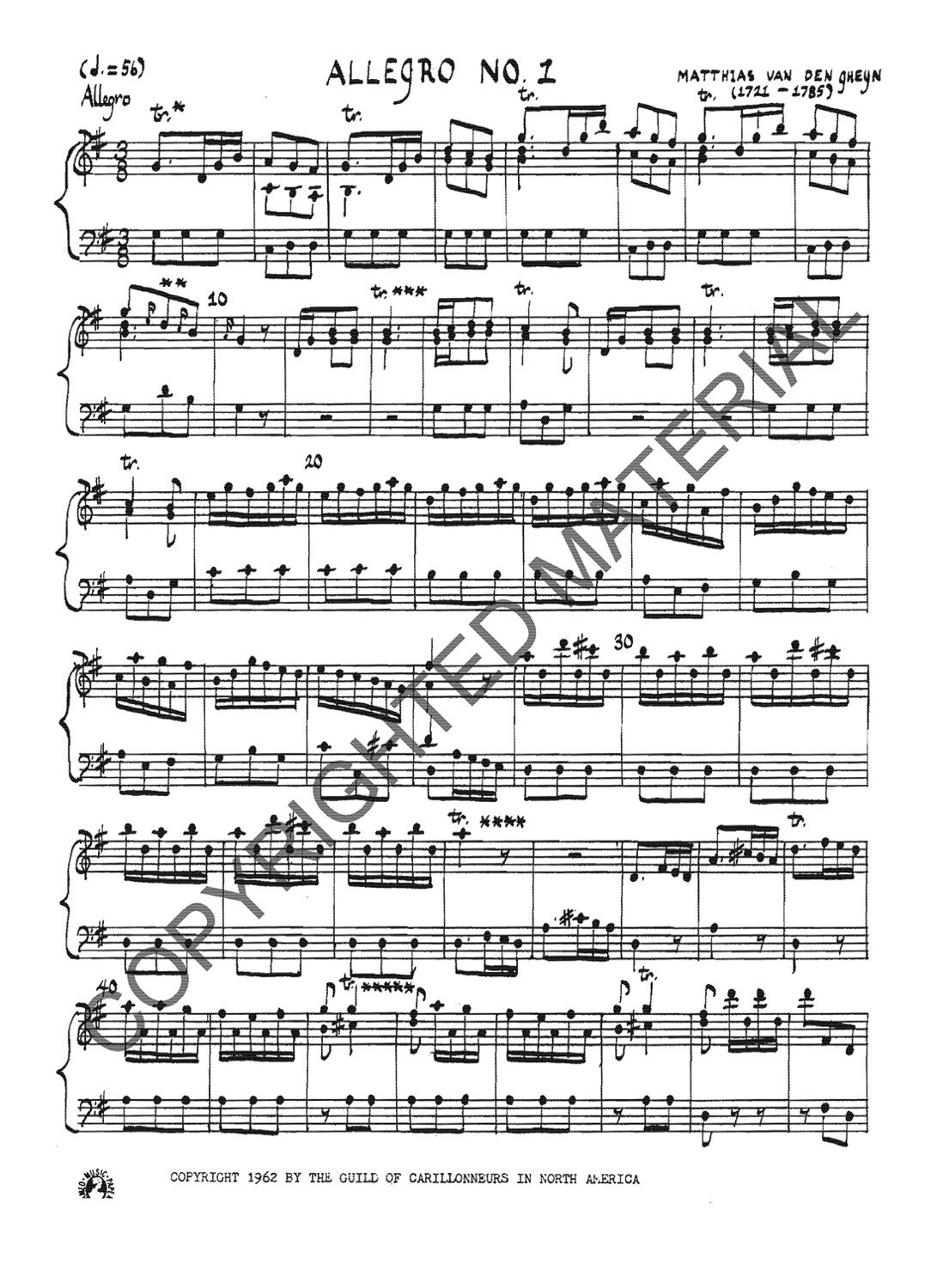
All 14 Vanden Gheyn Compositions
SKU 00216
US$55.00
1
Product Details
Title: The Complete Carillon Works of Matthias Van den Gheyn (1721–1785)
Composer: Vanden Gheyn, Matthias
Editor: Barnes, Ronald
Scoring: Carillon solo
Range: 3.5
Pages: 60
Publisher: GCNA
Collection contents
- Allegro No. 1 in G major (also sold under SKU01201)
- Allegro No. 2 in G major (also sold under SKU01202)
- Andante in D major (also sold under SKU01203)
- Preludio Coucou (also sold under SKU01204)
- Preludio No. 1 (also sold under SKU01205)
- Preludio No. 2 (also sold under SKU01206)
- Preludio No. 3 (also sold under SKU01207)
- Preludio No. 4 (also sold under SKU01208)
- Preludio No. 5 (also sold under SKU01209)
- Preludio No. 6 (also sold under SKU01210)
- Preludio No. 7 (also sold under SKU01211)
- Preludio No. 8 (also sold under SKU01212)
- Preludio No. 9 (also sold under SKU01213)
- Preludio No. 10 (also sold under SKU01214)
Front matter
INTRODUCTION. All fourteen of the carillon compositions of Matthias Van den Gheyn that are known to exist at the present time are included in this edition: ten preludes which comprise a set, an unnumbered prelude entitled Preludio Cou Cou, and three untitled pieces: two in G Major and the other, marked Andante, in D Major. One of the pieces in G Major has, with no justification, acquired the title of Rondo. The other is sometimes referred to as a fugue, but again without justification. In this edition they are both simply called Allegro, as they are marked in Van Elewyck's copy of them.
The manuscripts of these pieces were sought out between 1860 and 1862 by Chev. Xavier Van Elewyck, choirmaster at the Collegiate Church of Saint Peter in Louvain, Belgium, and copied under his direction "often in great haste," as part of his effort to rediscover as much of Van den Gheyn's music as he could. By 1862 when Van Elewyck presented his "notebook" of Van den Gheyn's compositions to François-Joseph Fétis, director of the Royal Conservatory of Music in Brussels, he had been able to find only these fourteen compositions for carillon. We must assume that no more have survived from Van den Gheyn's day, even though Van Elewyck includes marches and minuets for carillon in his list of the composer's works. If these pieces were known to Van Elewyck, they have disappeared since the time he conducted his research, as have the autographs of the other Van den Gheyn carillon works. For this reason, the Van Elewyck copy must be considered the primary source for this music, and it is from this source that the present edition has been prepared. [See publisher's note at conclusion]
Van Elewyck was profuse in his praise of these remarkable compositions for bells, especially the ten preludes and the Preludio Cou Cou. He was seemingly so anxious to discover more that he included Van den Gheyn's Morceaux Fugués in their number. The fugues are certainly not original works for carillon, but one or two of them have since achieved a certain degree of popularity, especially among Belgian carillonneurs in adaptations for the instrument. (Number four of the Morceaux Fugués was published in 1961 by The Guild of Carillonneurs in North America in an arrangement by Ira Schroeder. Van Elewyck arranged for the publication of the complete set of four in 1862, by Schott.) In light of Van Elewyck's large enthusiasm for the carillon works, it is difficult to understand why he did not arrange for their publication. As it was, only two of them—Preludio III and the Preludio Cou Cou—were published in Van Elewyck's Collection d'Œuvres Composées par d'anciens et de célèbres Clavecinistes Flamands, printed by Schott in 1877. Considering the increased popularity of several other of the carillon compositions among carillonneurs, it is even more remarkable that some of them have not found their way into print in more recent years. In this edition, all fourteen of the known carillon pieces of Van den Gheyn are seen in print for the first time. None has been published since Van Elewyck's efforts on their behalf in the 1860s. The Guild of Carillonneurs in North America is pleased to be able to issue the complete carillon works of Matthias Van den Gheyn as the first offering in a proposed special series of publications of historical carillon music. It is hoped that by making this music available in practical performing editions it will become more widely known and played, and will serve to enrich the repertoire of the modern Carillonneur both in North America and abroad.
Editorial Policies. This present edition is intended primarily as a set of practical performance scores rather than a scholarly work, but has been prepared with the greatest possible faithfulness to the primary source. Serious deviations from the Van Elewyck copy are noted wherever possible, without cluttering the scores. So many minor errors in copying occur in the primary source that it has been considered impractical to comment on every correction.
Current notational procedure has been followed wherever possible, but occasionally the exotic and archaic notation of Van Elewyck's copyist has been retained in passages where it seems to lend clarity to the composer's intentions. Note grouping, unless entirely impractical, appears exactly as in the Van Elewyck copy. Rests and note values in most cases remain the same as those found in the primary source. A considerable number of redundant accidental signs have been placed in parentheses above their notes, and all tempo indications and other directions for performance inserted by the editor are similarly enclosed. Changes in the actual placement of notes have been made only when obvious errors—and their obvious corrections—have been discovered. Serious and/or extended deviations from the source are fully identified in the text either in the form of "suggested interpretation" or in footnotes.
Pitch Level. It is not known for what carillon (or carillons) Van den Gheyn composed these pieces. As a consequence, their original pitch cannot be brought to bear as an influence on their performance in the twentieth century. For this reason, all fourteen pieces are given in this edition in their original key, even though many of them will sound too low when played on most large modern instruments. It is strongly suggested that this be seriously considered where adaptation for a particular instrument is concerned, and that satisfactory upward transposition be made in order that Van den Gheyn's music may sound clearly and effectively. It is probable that the lowest note (tenor c) appearing in Van den Gheyn's scores sounded approximately that pitch. If, in modern performance, the music is transposed so that it sounds at concert pitch, the result will be quite satisfactory.
Handling. No attempt has been made in this edition to indicate handling and pedaling since this still is, until the carillon becomes a standardized instrument, largely a matter of individual preference. In much of this music, the texture leaves little question as to which hand or which foot is required to sound a particular note.
Tempo. The metronomic tempo indications are in all cases merely suggestions on the part of the editor, and in all cases open to question by other players. It is hoped, however, that these guides may serve to point up the fact that not all carillon music must be played at precipitous speeds.
Dynamics. The sameness of texture in these pieces demands that dynamic variation be frequently brought to bear as a means of imparting the greatest possible range in expressive playing. No dynamic indications appear in the Van Elewyck copy, and the editor has inserted none, leaving the expressive interpretation entirely to the player.
Ornamentation and embellishment. None of the ten preludes or the Preludio Cou Cou contains a single sign or indication for the performance of melodic ornaments; indeed, the character of these pieces does not seem to call for any. At least one indication is given for arpeggiation of a cadence chord, and in several cases Van den Gheyn has written out the proper breaking-up of the otherwise solidly-written final chords. In no instance should these terminating chords be played solidly, but should be broken in performance in a manner consistent with the character and texture of the passage immediately preceding the final cadence. The realized cadences of preludes 8 and 9 may be considered as valid guides for the performance of these block chords.
The three non-preludio pieces. It is probably pure coincidence that the three "non-preludio" pieces naturally fall into the form of the rococo sonata: an opening movement in a lively tempo which establishes the tonality of the total work (in this case G Major), a middle movement in a slower tempo which departs from the basic tonality, but is case in a near-related key (D Major), and a concluding movement in a fast tempo which re-establishes the tonality introduced in the first movement. The editor wishes to emphasize the fact that there is no indication, other than that mentioned above, that these three pieces were originally intended to be linked together, but merely suggests that by so joining them the modern carillonneur is given a "major work" for carillon in rococo sonata form with which to enhance the interest and attractiveness of his recital programs. No artistic damage is done any of the three by combining them; on the contrary, all three may possibly gain in stature by becoming a part of a larger entity.
—Ronald Barnes; Lawrence, Kansas; April 1962
Publisher's Note: The missing autograph of Van den Gheyn's Preludia and other works mentioned by Barnes was finally unearthed on April 19, 1995, and was acquired by the Louvain University Archives. A facsimile of the autograph, together with a performance realization and text commentary, is available from Alamire, P.O. Box 45, 3990 Peer, Belgium: Gilbert Huybens & Luc Rombouts, Preludes for Carillon, 1997. This work is "dedicated to Xavier van Elewyck and Ronald Barnes, with respect for the roles played by each in studying the work of Matthias Van den Gheyn."
Save this product for later
All 14 Vanden Gheyn Compositions
You May Also Like
![[PDF] All 14 Vanden Gheyn Compositions](https://d2j6dbq0eux0bg.cloudfront.net/images/9481258/983392377.jpg "[PDF] All 14 Vanden Gheyn Compositions")
Powered by Lightspeed
Display prices in:USD
