
Categories
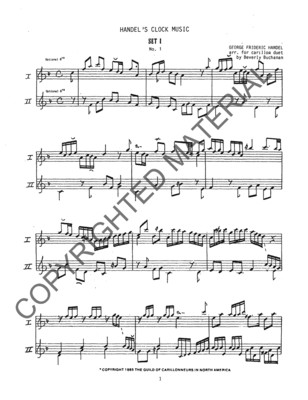
![[PDF] Complete Clock Music, Sets I and II](https://d2j6dbq0eux0bg.cloudfront.net/images/9481258/products/276315133/983392412.jpg "[PDF] Complete Clock Music, Sets I and II")
[PDF] Complete Clock Music, Sets I and II
SKU 01396
US$15.00
Duet (for 2 players)
1
Product Details
Title: Complete Clock Music, Sets I and II
Composer: Handel, George Frideric
Arranger: Buchanan, Beverly; De Turk, William
Scoring: Carillon duet
Range: 2
Pages: 28
Year completed: 1966, 1967
Year published: 1985
Publisher: GCNA
Catalog number: B-7
Collection contents
- Set I, No. 1
- Set I, No. 2
- Set I, No. 3
- Set I, No. 4
- Set I, No. 5
- Set I, No. 6
- Set I, No. 7
- Set I, No. 8
- Set I, No. 9
- Set I, No. 10
- Set I, No. 11
- Set II, No. 1
- Set II, No. 2
- Set II, No. 4
- Set II, No. 5
- Set II, No. 6
- Set II, No. 7
Performance notes
Set I is arranged for duet performance, while Set II is arranged for solo performance.
Front matter
Beverly Buchanan and I had a two-fold purpose in publishing this collection: to present all of the known Handel clockpieces in the 300th anniversary year of the composer, and to do so as faithfully as possible based upon the original manuscripts. In order to accomplish the latter, most of the pieces areset in duet form, enabling virtually all of the composer's notes to be played.
The first North American edition (and possibly the first anywhere) for the carillon was issued in 1939 by Percival Price, Dominion Carillonneur, and published by the Department of Public Works, Dominion of Canada. It was comprised of four pieces entitled "Sonata for a Musical Clock" by Handel and was heavily edited for use as teaching pieces. Indeed, most of his students began with these same four pieces! Since then, other editions have appeared. Most of them are incomplete. In some editions a bass line has been added to the easier pieces, and for the more difficult ones, a simplification process has made it possible for one person to play. In most editions I have seen, there are either notational mistakes or deliberate variances from the Handel manuscripts. Some editions have appeared with fabricated titles and/or poetry.
The manuscripts upon which all editions are based reside in the Royal Music Library of the British Museum in London. They give the following indications (parenthesis indicate editorial marks: the pieces are in two sets but not numbered):
SET 1: Ten Tunes for Clay's Musical Clock (there are actually eleven tunes)
- –
- –
- –
- Dell' opera Sosarmes ("Vola l'augello")
- Allegro
- 'Alla fama dimmi il vero' dell' opera Ottone
- opera Ariadne ("Deh lascia un bel desio")
- Allegro
- Della opera Ottone ('Dell' onda ai fieri moti')
- "In mille dolci modi", Act II, Opera Sosarmes
- –
SET II: Sonata by Mr. Handel For a Musical Clock
- –
- –
- A Voluntary on (or?) a Flight of Angels
- –
- –
- Menuet
- Air
In a comparisin of these manuscripts with others of Handel's, it is apparent to me that Set I is in the composer's calligraphy while Set Il is not. The latter may have been copied by John Christopher Smith (Johann Christoph Schmidt) of Ansbach, Germany, Handel's copyist, secretary and protégé.
In considering a carillon performance of these pieces, several points should be made:
- The pieces are not numbered and therefore it should not be assumed that there is any specific order (they are numbered here only for reference).
- The lower part in numbers 1, 2, and 3 of Set I were originally notated one octave lower. This would be unfeasible on the carillon. They may have been so notated for the sake of expediency.
- The musical clock that played these pieces probably produced high, light sounds. We know that it had dampers. Having played these pieces for many years, we suggest they be played one octave higher than written, unless the carillon is already very high-pitched. This also provides a refreshing new color for recital programming.
- Set II raises a number of questions. It is in a different calligraphy Set I, and the title "Sonata by Mr. Handel..." sounds more like a copyist's wording than a composer's. Was the "Sonata" Handel's title or the copyist's? Does it refer to all seven pieces, the four which have no title (#1, 2, 4, 5 as in Percival Price's edition), or some other configuration?
Because #3 of Set II is the same as #2 of Set I, we have eliminated the repetition in Set II. In comparing these two settings, #3 differs from #2 in that it was written on two treble clef staves: the lower part is one octave higher. It contains fewer ornaments. The title, "A Voluntary on a Flight of Angels" appears on #3 only, and in a script unlike the other titles (added by someone else?). It is also unclear from the manuscript whether the third word of the title is "on" or "or".
These pieces do not appear in Chrysander's life of Handel (G. F. Händel by Friedrich Chrysander, Leipzig, 1858), in the Handel Gesellschaft, or in other biographies of the composer. They surfaced as part of a larger collection of manuscripts which were being sold in 1918. An informative article appeared in The Musical Quarterly (v. 5 no. 4, October 1919) which is reprinted on the next page.
Finally, the reader is referred to a detailed study of Handel and his bell music by Percival Price, entitled "Mr. Handel and His Carillon" (GCNA Bulletin, v. 20, May 1969) which is available from the GCNA Archivist (William De Turk, 900 Burton Tower, Univ. of Mich., Ann Arbor, MI 48109).
—William De Turk; Ann Arbor, Michigan; Fall 1985
Save this product for later
[PDF] Complete Clock Music, Sets I and II
You May Also Like
Powered by Lightspeed
Display prices in:USD
