
Categories
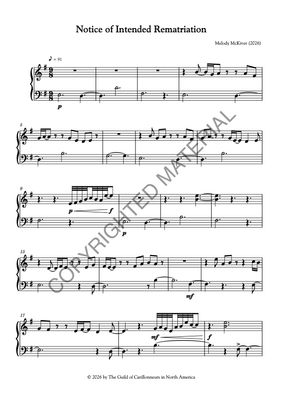
![[PDF] Notice of Intended Rematriation](https://d2j6dbq0eux0bg.cloudfront.net/images/9481258/products/837307619/5782162869.jpg "[PDF] Notice of Intended Rematriation")
[PDF] Notice of Intended Rematriation
SKU 01757
US$4.00
New from 2026
1
Product Details
Title: Notice of Intended Rematriation
Composer: McKiver, Melody
Scoring: Carillon solo
Range: 2(+e)
Pages: 4
Year completed: 2026
Year published: 2026
Publisher: GCNA
Catalog number: 2026-C6
Notices
- This title was commissioned by the Johan Franco Composition Fund of The Guild of Carillonneurs in North America.
Program notes
Rematriation is an Indigenous feminist paradigm, an embodied praxis of recovery and return, and a sociopolitical mode of resurgence and refusal. Rematriation is more than a play on words; it is the antithesis of repatriation. Rematriation recasts questions of nationhood, personhood, law, property, ownership, and rights on new terms.
Reminding us of the sociopolitical power derived from matrilineal societies, rematriation celebrates the leadership and labor of Indigenous women and affirms matriarchal authority.
—ROBIN R. R. GRAY (Ts'msyen / Mikisew Cree), "Rematriation" (2022)
In my compositional practice I integrate Anishinaabeg methodologies by accounting for connection to place and locating my music within a broader socio-political context which considers Indigenous epistemologies and responses to colonialism. This piece will be premiered on the Yale Memorial Carillon at Yale University in June of 2026. Beyond watching scenes of the Gilmore Girls filmed at Yale, I had very little context for a campus that I've never visited.
Research on the Yale Memorial Carillon brought to my attention its location within Harkness Tower. A series of eight-foot tall statues of Yale "worthies" is included on the lower level of sculpture.1 James Fenimore Cooper's name jumped out at me—best known for his 1826 novel The Last of the Mohicans, one of the most infamous romanticized and stereotypical portrayals of the colonial "Indian" in American literature and cinema from the nineteenth century to the present. Further research brought me to Eli Whitney, whose invention of the cotton gin "became closely associated with the brutal expansion of slavery and cotton cultivation in the antebellum South."2
I'm up against decades and perhaps centuries of a literary history that extracted from our declarations of pain evidence of our inability to locate joy at the centre of our desire to exist. With you, I can rally against this parasitic way of reading, this time-worn liberal sensibility.
—BILLY-RAY BELCOURT (Cree), "A History of My Brief Body" (2020)
Considering these monuments to anti-Black and anti-Indigenous figures Cooper, Whitney, et al. surrounding the carillon at Yale, my search led to wondering what ongoing violations Yale as an organization continues to perpetuate against Indigenous nations. A friend suggested looking into the status of Indigenous human remains and burial items at Yale, and a search of the Native American Graves Protection and Repatriation Act (NAGPRA) confirmed numerous Ancestors stored within the Yale Peabody Museum of Natural History3 and the Yale University Art Gallery.4
I took inspiration from a NAGPRA notice issued on September 25, 2025, which identifies an "engraved silver armband... made by Joseph Richardson Jr. (1752–1831)" which was "removed from a burial mound in or near Cross Village, Emmet County, in Michigan, by the blacksmith of the village, by 1898. The item subsequently passed into the collections of Philip H. Dilg, in Chicago, Illinois, and Cornelius Titus Geesey, who sold the cultural item to the YUAG in 1948. A relationship of shared group identity can be clearly and reasonably traced between the cultural item and the Little Traverse Bay Bands of Odawa Indians."5 As an Anishinaabe-Ojibwe composer, I felt drawn to this particular listing as the Odawa are fellow Anishinaabe members of the Three Fires Confederacy, though I do not have any direct ties to the Little Traverse Bay Bands of Odawa Indians. It felt important to try and conceptualize a specific item rather than a broader construction of NAGPRA violations at Yale. Dates pertaining to this engraved silver armband helped inform some of the tempi, time signatures, and overall form of Notice of Intended Rematriation. Though I take consideration of common Anishinaabeg melodic development patterns, no musical motifs are taken from any pre-existing Anishinaabe songs, and this is an original work conceived for carillon. Rather than enshrining repatriation structures as defined by the U.S. Government, I wanted to acknowledge rematriation frameworks that are articulated within Indigenous community organizing that center resurgence and refusal as Robin Gray so eloquently states above. It is my hope that by sounding out an "instrument of colonialism"6 across these contested grounds, the Ancestors that remain held captive within those colonial walls can listen and be honoured.
- Tritia Yamasaki, "The Character of Harkness Tower," Yale University Guild of Carillonneurs, January 1, 1996, http://yalecarillon.org/about-carillon/documents?doc=character-of-harkness-tower.
- Ariel Ron, "How Eli Whitney single-handedly started the Civil War...and why that's not true," Commonplace: The Journal of Early American Life (October 2025), https://commonplace.online/article/how-eli-whitney-single-handedly-started-the-civil-war.
- "Notice of Inventory Completion: Peabody Museum of Natural History, Yale University, New Haven, CT," U.S. Fish & Wildlife Service, May 24, 2024, https://www.fws.gov/federal-register-file/notice-inventory-completion-peabody-museum-natural-history-yale-university-11.
- "Notice of Intended Repatriation: Yale University Art Gallery, New Haven, CT," Federal Register, September 12, 2025, https://www.federalregister.gov/d/2025-17631.
- "Notice of Inventory Completion: Yale Peabody Museum, Yale University, New Haven, CT." Federal Register, March 27, 2025, https://www.federalregister.gov/d/2025-05223.
- Patrick Nickleson, "The Message of the Carillon: Bells as Instruments of Colonialism in Twentieth-Century Canada," Intersections 36, no. 2 (2016): 13–25, https://doi.org/10.7202/1051594ar.
—Melody McKiver
Save this product for later
[PDF] Notice of Intended Rematriation
You May Also Like
Powered by Lightspeed
Display prices in:USD
