
Categories
![[PDF] The Belmont Carillon Book, Volume II](https://d2j6dbq0eux0bg.cloudfront.net/images/9481258/983700743.jpg "[PDF] The Belmont Carillon Book, Volume II")
[PDF] The Belmont Carillon Book, Volume II
SKU 01392
US$30.00
1
Product Details
Title: The Belmont Carillon Book, Volume II
Composer: Various
Arranger: Various
Editor: Buchanan, Beverly
Scoring: Carillon solo
Range: 2
Pages: 95
Year published: 1994
Publisher: GCNA
Catalog number: B-13
Collection contents
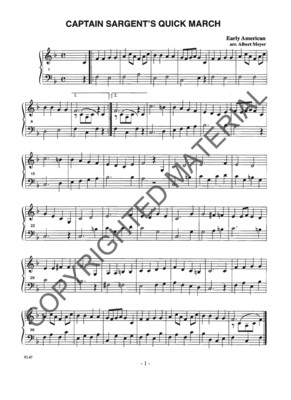
- Captain Sargent's Quick March
- You're a Grand Old Flag
- Come Thou Fount of Every Blessing (Nettleton)
- For the Beauty of the Earth (Dix)
- Come Sing to God, O Living Saints (Ellacombe)
- Praise God, from Whom All Blessings Flow (Old Hundredth)
- Now Thank We All Our God (Nun Danket)
- Nun Danket Alle Gott (Bach cantata #79)
- We Come as Guests Invited (Wie Lieblich is den Maien)
- We Gather Together (Kremser)
- We Plow the Fields, and Scatter (Wir Pflügen)
- When I Survey the Wondrous Cross (Rockingham)
- Marche de Hanover (De Gruytters #1)
- Marche (De Gruytters (#2)
- Menuet (De Gruytters #3)
- Menuet (De Gruytters #4)
- Marche (Dupont #1)
- Coronation March
- Intermezzo for Carillon
- Belmont Suite (Prelude, Slow Jig, Final Flourish)
- Festival Prelude for Carillon (please see errata below)
- Etude for Carillon
- Muss I Den
- Two Irish Jigs (St. Patrick's Day, Father O'Flynn)
- Mexicanos, al grito de guerra (Mexican national anthem)
- Las Mañanitas
- Stillness
- All the Pretty Little Horses
- Land of Rest
- Country Dance (guitar)
- Marche en Rondeau (prelude to Te Deum)
- La Barriera
- I Am a Courtier, from The Gondoliers
- Little Buttercup, from H.M.S. Pinafore
- Rondo, K. 13
- Suite in F Major (Witt)
Front matter
There are enough two-octave carillons to justify the time spent in researching and arranging music for them. When I served as Chairman of the Committee on Music Publications for the G.C.N.A., I was aware of the need and occasionally published a token piece or two.
It wasn't until I began playing a carillon of 23 bells that I took the need seriously. In 1988 after playing the 50 bell carillon at Christ Church Cranbrook in Bloomfield Hills, Michigan for over 20 years, we moved to Tennessee. The closest carillon was a recently installed instrument of 23 bells at Belmont College, (now Belmont University), Nashville.
It has been an interesting challenge to research music, arrange and adapt it to two octaves and to make it interesting for the performer and the listener. I have found that music for the small carillon can be just as rewarding as music for larger instruments; the difference is having fewer bells to work with.
The Belmont Carillon Book, Volume II is the second in the Belmont Carillon Book series. Volume I was published in 1991. May the selections be useful to others who play, and will have the opportunity to play, a small carillon.
In addition to my own arrangements and transcriptions, I have used the extensive collection of 2-octave music which Frank Griesinger thoughtfully provided on microfilm many years ago. Another valuable source was the Percival Price collection, now stored at the National Library of Canada in Ottawa, Ontario, Canada. My thanks to Belmont University for providing me with a grant to visit the National Library, to Dr. Stephen Willis for his assistance in providing access to and allowing photocopying of the manuscripts and to Daphne Price McCree for her hospitality and encouragement while in Ottawa.
The music notation has all been done on my Apple Macintosh computer using the music notation software Finale™ by Coda.
As with Volume I, the selections cover a range of difficulty. There are selections for the beginner as well as some for the experienced player. For uniformity, collection are notated in the range:

The carillon at Belmont University has 23 bells, weighing 1188 pounds to 58 pounds. The pedal board extends 1 1/2 octaves. For those playing instruments with only one-octave pedal range, some occasional adjusting will be necessary.
Just as with larger carillons, some music lends itself better to heavier or lighter instruments. This is also true with the small instrument. However, with the material contained in this book, may there be "something for everyone."
Errata
Concerning Festival Prelude for Carillon: In measure 9, the treble D on beat 2 should be D♯, but the sharp sign is missing. The next D on beat 6 needs a natural sign. Please mark your score accordingly. The GCNA apologizes for this error.
Save this product for later
[PDF] The Belmont Carillon Book, Volume II
You May Also Like
Powered by Lightspeed
Display prices in:USD
